Bluebook Practice Test Score Conversion Guide
Learn how a Bluebook practice test becomes Reading and Writing, Math, and total scores, then use the report to plan your next study block.

What Bluebook Practice Test Score Conversion Means
The report is a scored practice result, not a hand calculation that can be recreated from one visible percentage.
When students search for Bluebook practice test score conversion, they are usually asking one of two questions: where did the score come from, or how can the result be compared with another practice attempt? Start by separating the answer count from the reported score. A correct answer contributes to the performance information used by the scoring model, while the report displays scaled section scores. Those are related numbers, but they are not interchangeable.
The Digital SAT has two sections. Reading and Writing and Math are each reported on a 200 to 800 scale, and the total is their sum on a 400 to 1600 scale. Bluebook presents that structure after you finish a full practice test. It may also show performance information by content domain, which helps explain where the score came from without pretending that each question had a fixed scaled value.
This page focuses on a completed digital practice test delivered through Bluebook. The site also has a SAT Practice Test Score Calculator for adding known section scores or making a broad raw-answer estimate. That calculator is useful when you need a quick comparison; it does not replace the score report attached to the exact Bluebook form you completed.
The most useful interpretation is therefore a sequence: read the official practice result, preserve the two section scores, inspect the domain feedback, and then compare repeated attempts under similar conditions. That sequence answers the conversion question without turning an estimate into a promise about your official SAT.
Write down the test source, date, section scores, and whether the result came from Bluebook or a paper table. A number without its scoring source is difficult to compare fairly.
How Bluebook Turns Answers Into Section Scores
Bluebook follows the Digital SAT structure, so the conversion includes the two-module section design and form-specific scoring information.
A Bluebook practice test is designed to resemble the digital SAT experience. Reading and Writing has two modules, and Math has two modules. The second module is selected using performance in the first module, so two students can answer a similar number of questions correctly but receive different module mixes. That adaptive path is part of the context for the reported section score.
The visible report is a scaled score, not simply a percentage. The scoring process considers the questions answered correctly and the characteristics of the form. College Board describes this as a process that supports comparable scores across different test forms. A public calculator can model a range, but it cannot see every item-level detail or reproduce the private scoring record for your attempt.
The total is simpler than the conversion: add the Reading and Writing score to the Math score. For example, 680 Reading and Writing plus 650 Math equals 1330. That arithmetic is exact once both section scores are reported. The uncertain part is the estimate before Bluebook has produced those section values.
This is also why a paper practice guide should not be mixed into a Bluebook result. Paper versions may use a form-specific raw-to-range table with different question counts and endpoints. Use the source that matches the way you took the test, then keep any public estimate clearly labeled as an estimate.
| Layer | What you can read | What it does not prove |
|---|---|---|
| Correct answers | Your answer record for the two sections and modules | A fixed number of scaled points per question |
| Section score | Reading and Writing or Math from 200 to 800 | That the same raw count will always produce the same score |
| Total score | The two section scores added on a 400 to 1600 scale | Admission odds or an official test-day result |
| Domain feedback | Content areas to review next | A second score that should be added to the total |
- 1. Complete both modules in Reading and Writing and both modules in Math under the stated timing.
- 2. Let Bluebook finish its scoring process instead of converting a percentage by hand.
- 3. Record the two section scores before recording the total.
- 4. Save the domain feedback and missed-question notes beside the score.
- 5. Compare the result only with practice tests that used a similar source and testing condition.
How to Find and Read Your Bluebook Score Report
The report and My Practice account are the first places to check after a completed official practice test.
If you just finished a Bluebook practice test, wait for the app to finish processing and look for the score review or results screen. For older attempts, College Board directs students to My Practice using the same account or sign-in details used for Bluebook. The exact labels can change, but the useful evidence is stable: identify the test attempt, confirm the date, and open the detailed score view rather than copying a single headline number.
Read Reading and Writing and Math separately. A total such as 1330 is useful for trend tracking, but it cannot tell you whether the next study block should focus on algebra, advanced math, grammar, or reading evidence. The domain bars or skill indicators are not extra points; they are diagnostic information that explains the section result.
When you save the result, include the practice-test name or number, the date, the two section scores, and any note about unusual conditions. A late start, repeated pause, calculator issue, or interrupted session can make a score less comparable with a normal attempt. Keeping the context prevents false conclusions when you compare scores later.
- Open Bluebook or My Practice with the account used for the attempt.
- Choose the correct practice test and verify the attempt date before copying values.
- Record Reading and Writing, Math, and total scores in separate fields.
- Open the content-domain feedback and mark two or three review priorities.
- Save the report or a personal score note so the source remains clear.
If a result has not appeared, check the account and the attempt status first. A table from another practice form cannot recreate a pending Bluebook report.
Why the Same Number Correct Is Not a Fixed SAT Score
A raw count leaves out the module path, item context, and form information that a Bluebook report uses.
A common shortcut says that one question is worth a fixed number of SAT points. That shortcut fails for the Digital SAT because the two sections have different question counts and because the adaptive route changes the context of the second module. The same number of correct answers in Math and Reading and Writing is not the same performance, and the same section count is not a guarantee across every form.
Question difficulty also matters to interpretation. The public result does not give you a simple list of scaled point values for every item. Instead, it reports a section score after the test's scoring process. This is why a broad estimate can be honest when it is shown as a range, while a precise claim such as 'four misses always equals 720' is not defensible.
Use the official report when it exists. If you are practicing on paper, use the matching College Board scoring guide for that form. If you only have correct-answer counts from a digital-style attempt, use the main SAT score calculator or the score chart as a directional reference and retain the caveat that the actual Bluebook conversion can differ.
The difference is not a reason to ignore raw answers. Raw answers are excellent for error review, pacing checks, and deciding which domain to study. They are simply a different layer of information from the scaled score. Keep both layers in your notes instead of forcing one to stand in for the other.
Adaptive path
Module 1 performance influences the Module 2 difficulty mix. The route is part of the score context, even though the report does not ask you to calculate it manually.
Form and item context
Different forms can use different item sets and scoring information. A public table can illustrate a range, but it cannot be treated as the private conversion record for every Bluebook attempt.
Practice versus official
A Bluebook practice score is a useful readiness signal. It is not an official SAT score report and should not be used as a guaranteed admissions outcome.
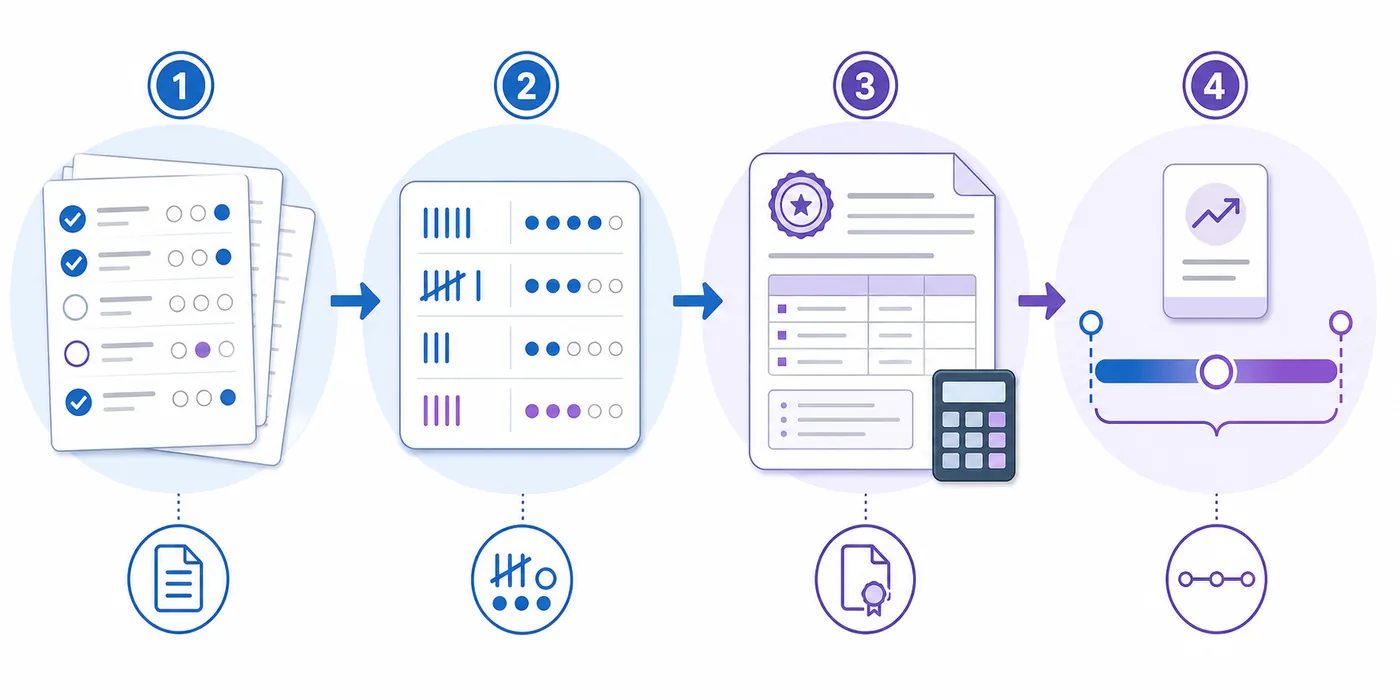
Worked Examples for Reading and Writing, Math, and Total Score
Examples make the arithmetic clear while keeping the uncertain conversion step visible.
Suppose Bluebook reports 680 in Reading and Writing and 650 in Math. The total is 1330 because 680 plus 650 equals 1330. There is no need to estimate the total again. The useful next question is what the domain feedback says about the two sections and whether the conditions match your other attempts.
Now suppose you only counted 47 correct in Reading and Writing and 37 correct in Math. Those counts can support a rough planning estimate, but they do not identify every item characteristic or the exact adaptive path. Enter the values in the SAT Practice Test Score Calculator if you need a broad comparison, then label the result as an estimate rather than a Bluebook report.
Finally, compare a 1330 from Bluebook with a 1330 from a paper worksheet only after checking the source. The same total may be useful for a progress graph, but the underlying conversion method and uncertainty may be different. A fair comparison records the source beside the number.
| Situation | What is safe to calculate | How to label it |
|---|---|---|
| 680 Reading and Writing + 650 Math shown in Bluebook | 1330 total | Reported Bluebook practice score |
| 47/54 Reading and Writing + 37/44 Math counted by hand | A directional section and total range | Raw-answer estimate |
| Paper worksheet with a form-specific table | Add the two published section ranges | Paper-form conversion range |
| Two attempts with the same total but different section splits | Compare section balance and domains | Same total, different study signal |
| Attempt interrupted or taken without timing | Use the result as a rough diagnostic | Limited comparability |
Turn a Bluebook Result Into a Study Plan
A score becomes more useful when it leads to a specific review action instead of a single target number.
After saving the result, review missed questions before opening another full test. Tag each miss as a content gap, a reading or evidence mistake, a careless error, a timing problem, or an answer changed without a clear reason. This turns the report into a short list of actions and prevents the score from becoming the only feedback you remember.
Choose one section priority and one behavior priority for the next study block. For example, a lower Math score with several advanced-math misses may call for targeted practice, while a stronger Math score with rushed Reading and Writing endings may call for pacing checkpoints. Keep the action narrow enough to finish before the next timed attempt.
Use at least two comparable practice results before changing a long-term target. A single high score can reflect a familiar question set, and a single low score can reflect fatigue or a disrupted session. A small trend with the test source and conditions attached is more useful than a precise prediction based on one number.
When you are ready to compare the next result, keep the official Bluebook score as the anchor. The public calculator, score chart, and Digital SAT scoring guide can explain the range and the mechanics, but your plan should still be driven by the questions you missed and the skills you can practice.
Log the section split
Store Reading and Writing and Math separately so a flat total cannot hide a change in one section.
Review by cause
A content error, timing error, and careless error need different next steps. Tagging the cause keeps practice targeted.
Repeat comparable conditions
Use the official time limits, a quiet setup, and the same device rules when you want to compare two digital attempts.
Set a review date
Schedule the error review while the questions are still familiar, then choose the next full test only after the targeted work is complete.
What to Do When a Bluebook Score Is Missing
A delayed or incomplete report is an account and workflow problem first, not an invitation to guess a score.
If the Bluebook result is not visible, confirm that the test was submitted and that you are signed in with the account connected to the attempt. Check My Practice for the same test name and date. A practice score can take time to appear, and an interrupted session may not create the same report as a completed test.
Do not use a different form's conversion table to fill a missing result. Practice Test 6, Practice Test 7, Practice Test 8, and Bluebook digital attempts can use different scoring contexts. The site has separate guides for the paper worksheets because their ranges belong to those specific forms.
If you need a temporary study estimate, write down the raw counts, the source, and the reason the official result is unavailable. Use a range from the main calculator only as a placeholder for planning, then replace it with the Bluebook or College Board result when it becomes available.
- Confirm submission and reconnect to the same Bluebook or College Board account.
- Check My Practice for the matching test name and attempt date.
- Keep raw counts and timing notes in a temporary record rather than inventing a scaled score.
- Use a public estimate only for short-term study planning and mark it as pending.
- Replace the estimate with the official report before comparing long-term performance.
Bluebook Practice Test Score Conversion FAQ
Direct answers to the questions students ask after finishing an official digital practice test.
How does Bluebook practice test score conversion work?
Bluebook uses your answers from both modules in Reading and Writing and Math, the adaptive module path, and form-specific scoring information to report two scaled section scores. It then adds the sections into a 400 to 1600 total.
How do I get my Bluebook practice test score?
Finish and submit the practice test, open the result screen, and use My Practice with the same account for older attempts. Verify the test name and date before copying the section scores.
How do I see old Bluebook practice test scores?
Sign in to My Practice with the account connected to Bluebook and select the matching practice attempt. Keep the date and test name beside the result so you do not mix forms.
Is a Bluebook practice score the same as an official SAT score?
No. It is an official practice experience and a useful readiness signal, but it is not an administered SAT score report. Use it for planning and keep the distinction in your notes.
Can I convert a percentage into a Bluebook score?
A percentage can support a rough estimate, but it cannot reproduce the item-level and adaptive information in a Bluebook report. Use the report first, or label a calculator result as a directional estimate.
Why is my calculator result different from Bluebook?
A public calculator models a general range, while Bluebook has the exact practice form, answer record, adaptive context, and scoring information. The Bluebook report should be the authority for that attempt.
Do Bluebook practice tests give you a score?
Yes. A completed official Bluebook practice test provides section and total score information, along with diagnostic feedback. The timing of the result can vary, so check the attempt status and My Practice if it is not visible.
Should I use a paper SAT conversion table for Bluebook?
No. Use a paper table only for the paper version and form it names. A Bluebook digital attempt should be read from its own report; a general calculator can only provide a clearly labeled estimate.
How accurate is a Bluebook practice score?
It is one of the strongest practice indicators because it is built for the digital SAT format, but it is still not a guarantee. Compare several comparable attempts and review the section and domain pattern instead of relying on one number.
Use the Report First, Then Use Estimates Carefully
Bluebook practice test score conversion is easiest to understand when you keep the layers separate: answers feed a form-specific scoring process, the report gives two section scores, and the total is their sum. Raw counts and public calculators remain useful for review, but neither should overwrite the official practice report.
Save the test source, date, section split, domain feedback, and testing conditions. That small record turns a practice number into a repeatable study signal and makes future comparisons much fairer.
When you need another estimate, use the SAT Practice Test Score Calculator for a broad planning range, the SAT score chart for reference, and the Digital SAT scoring guide for the underlying mechanics.
Official references
Use first-party College Board pages for the current Bluebook workflow, My Practice access, test structure, and official score explanations.
- College Board - How to Use Bluebook Practice Tests — Official practice-test workflow, timing, and adaptive module context.
- College Board - My Practice 101 — Where to review a completed Bluebook practice attempt and its feedback.
- College Board - How SAT Scores Are Calculated — Why a raw answer count is not a universal scaled-score shortcut.
- College Board Research - Digital SAT Practice Tests — Research context for the relationship between official digital practice tests and SAT performance.