How Many Questions Can You Miss on the SAT?
There is no universal missed-question limit for a target score. The section, module path, and test form all change what a raw count can tell you.
Start With Your Target Score and Two Sections
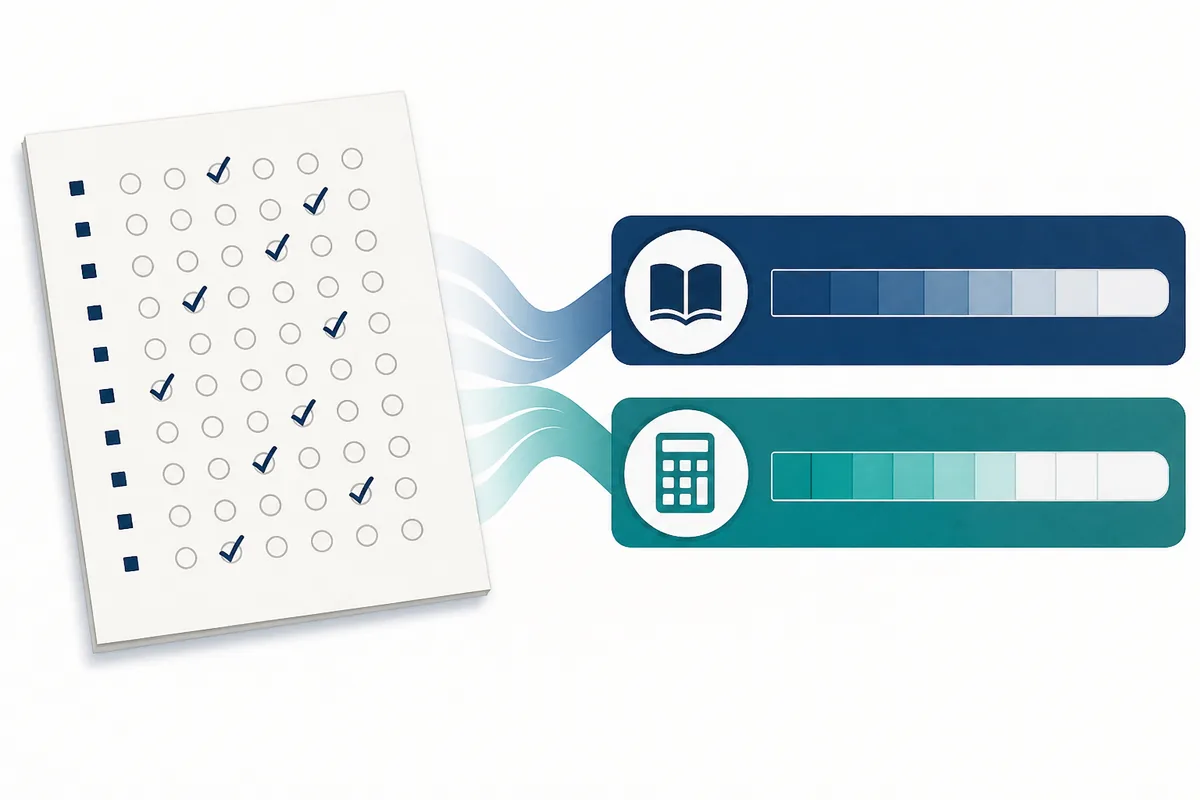
The total score is built from two scaled section scores, so translate a goal into section targets before counting misses.
The SAT total adds Math and Reading and Writing scaled scores. Each section ranges from 200 to 800; the total ranges from 400 to 1600. A 1500 goal could be 750 in each section or another split such as 770 Math plus 730 Reading and Writing. Neither split tells you the raw answers needed.
For a 1500 or 1400 goal, choose a section split first, then estimate each section from its own practice result. A combined miss count hides whether Math, Reading and Writing, or both sections need work.
| Target total | One balanced section target | Another possible scaled split |
|---|---|---|
| 1500 | 750 Math + 750 Reading and Writing | 770 Math + 730 Reading and Writing |
| 1400 | 700 Math + 700 Reading and Writing | 740 Math + 660 Reading and Writing |
| 1300 | 650 Math + 650 Reading and Writing | 680 Math + 620 Reading and Writing |
The table shows arithmetic combinations on the scaled score range. It does not say that a certain number of missed answers always produces one of these section scores.
Why the Same Number of Misses Can Score Differently
An overall wrong-answer count leaves out information the SAT scoring process uses.
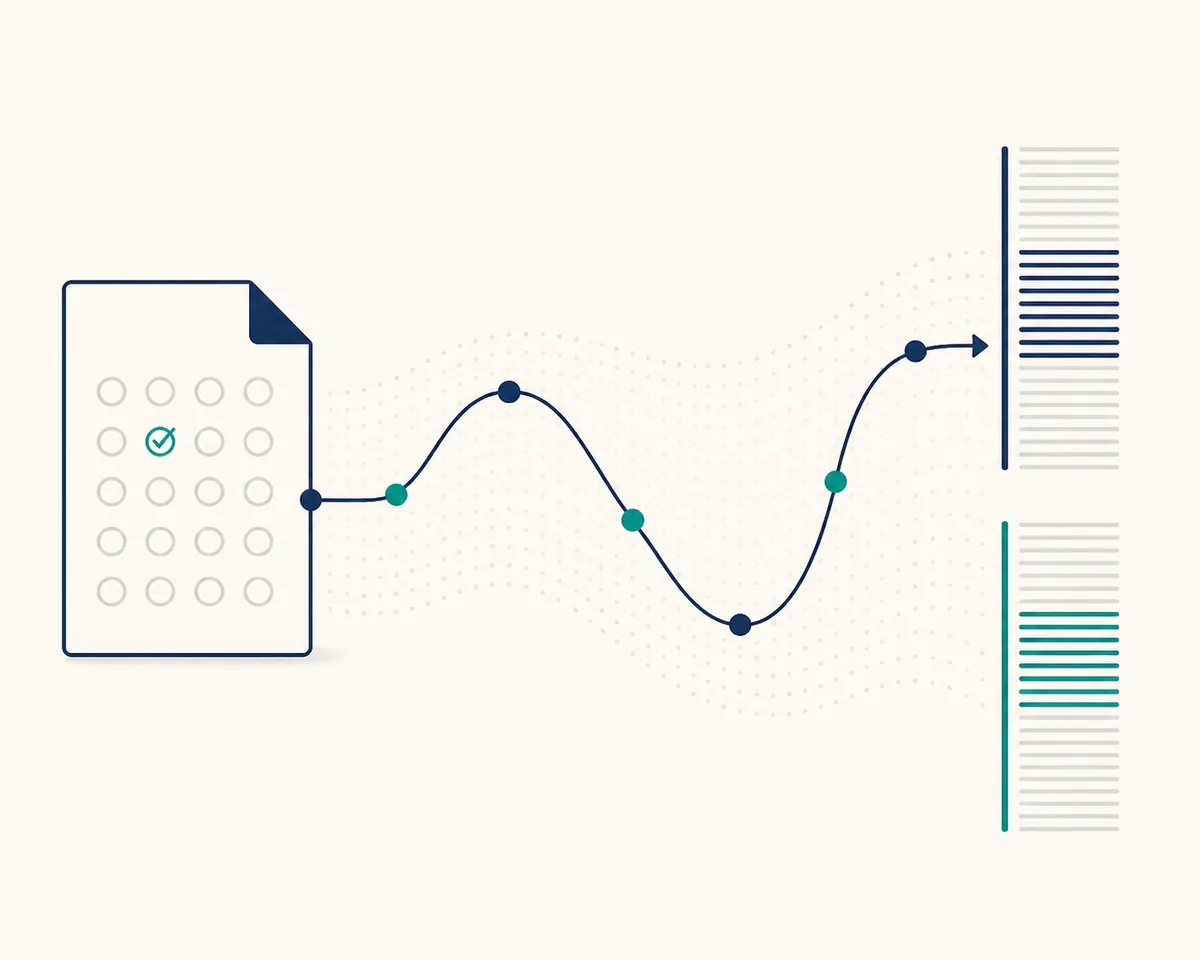
Math and Reading and Writing are separate sections with 44 and 54 questions, respectively, split across two modules each. Nine misses across both sections are not the same raw result as nine Math misses, so one combined count cannot determine either section score.
The Digital SAT is multistage adaptive: Module 1 performance helps determine the Module 2 difficulty mix. Question characteristics and test-form differences also affect conversion, so similar correct counts can lead to different estimates.
Some questions may be unscored pretest items and are not identified to students. Use a practice estimate as a planning range; the official score report is the result for an administered SAT.
Keep section counts separate
Track Math and Reading and Writing correct answers independently; each section has its own question count and conversion.
A wrong answer is not a scaled-point penalty
For raw scoring, a correct answer adds one point within its section. There is no separate penalty that subtracts a fixed number of scaled-score points for a wrong answer.
Estimate Your Score From a Practice-Test Result
Keep the known raw count separate from the estimated scaled score.
Work backward from misses within each section, not from one overall percentage. Compare results using the same form and scoring reference.
- Record Math and Reading and Writing separately: a standard Digital SAT has 44 Math and 54 Reading and Writing questions.
- Subtract misses within each section. Four Math misses means 40/44 correct, but that raw count alone is not a scaled score.
- Note the practice-test form. Use its official conversion table when available; otherwise use a calculator that explains its estimate method.
- Compare both section estimates with your target split, such as 750 + 750 for a 1500 total.
- Label the result an estimate. Only the official score report gives the result for an administered SAT.
Enter each section's correct count in the SAT score calculator, or compare ranges in the SAT score chart.
Examples: What a Missed-Question Count Can Tell You
These examples show how to use the raw count without pretending it fixes the scaled score.
Two students can each miss nine questions but have different section results. Student A misses four Math and five Reading and Writing questions; Student B misses seven Math and two Reading and Writing questions.
That gives A raw counts of 40/44 Math and 49/54 Reading and Writing, versus B's 37/44 and 52/54. Estimate each section with the same form-specific table or calculator; these raw examples do not establish a scaled score.
| Practice result | Math raw result | Reading and Writing raw result | What remains unknown |
|---|---|---|---|
| A: 9 misses | 4 missed; 40/44 correct | 5 missed; 49/54 correct | The scaled score depends on the form and module path. |
| B: 9 misses | 7 missed; 37/44 correct | 2 missed; 52/54 correct | The same total misses do not create the same section mix. |
Ask whether each section is near your chosen 1500 split, such as 750 + 750. Do not ask a calculator to turn nine total misses into one universal SAT score.
What to Do After a Practice Test
The value of counting misses is deciding what to practice next, not chasing an exact point cost for every question.
Review missed and guessed questions by cause: content gap, misread prompt, rushed calculation, unfamiliar word, or pacing. This turns a score estimate into a specific study plan.
Practice a skill when the same error repeats; try a timed section when misses span unrelated topics. Compare like-for-like forms and keep raw counts beside score estimates.
- Review missed and guessed questions, then group errors by skill and section.
- Group errors by section so a strong total does not hide a weaker area.
- Recheck your target split with the SAT Math score calculator and Reading and Writing score calculator.
- Use the Digital SAT scoring guide to understand why adaptive modules and score conversion affect estimates.
SAT Missed-Question FAQ
Answers about missed questions, target scores, and practice estimates.
How many questions can I get wrong on the SAT to get a 1500?
There is no universal missed-question count for a 1500. A balanced scaled-score target is 750 Math plus 750 Reading and Writing, but the raw correct answers needed can vary by section, module path, and test form. Estimate each section separately.
Are Math and Reading and Writing misses worth the same number of points?
Each correct answer contributes one raw point within its own section. That does not mean one missed question always changes the scaled score by the same amount in Math and Reading and Writing.
Does a wrong SAT answer lower my score more than leaving it blank?
The SAT does not add a guessing penalty. A wrong or blank answer does not add a raw point, so answer every question when time allows rather than leaving one blank to avoid an extra deduction.
Can I calculate my SAT score from the number of questions I got right?
You can estimate a practice score by entering Math and Reading and Writing correct counts separately. A calculator or chart gives a planning range; it cannot replace the official score report for an actual test.
Does the SAT show exactly which questions I missed?
A general score estimate does not identify missed items. Keep your practice-test answer review for question-level feedback, and use the official score report for the result of an administered test.
Use Misses to Plan Your Next Step
There is no fixed missed-question count for a score goal. Set section targets, estimate each raw count with the right form, then review errors to choose what to study next.
Official sources
- College Board — How SAT Scores Are Calculated — Official explanation of raw scoring, adaptive modules, question characteristics, and score conversion.
- College Board — How the SAT Is Structured — Official section structure, question counts, and module information.