What Is the SAT Out Of? Total Score, Sections, and Decimals
The SAT total score runs from 400 to 1600. Here is how the two 200–800 section scores fit together, what the maximum means, and why a score such as 1560.5 is not an official result.
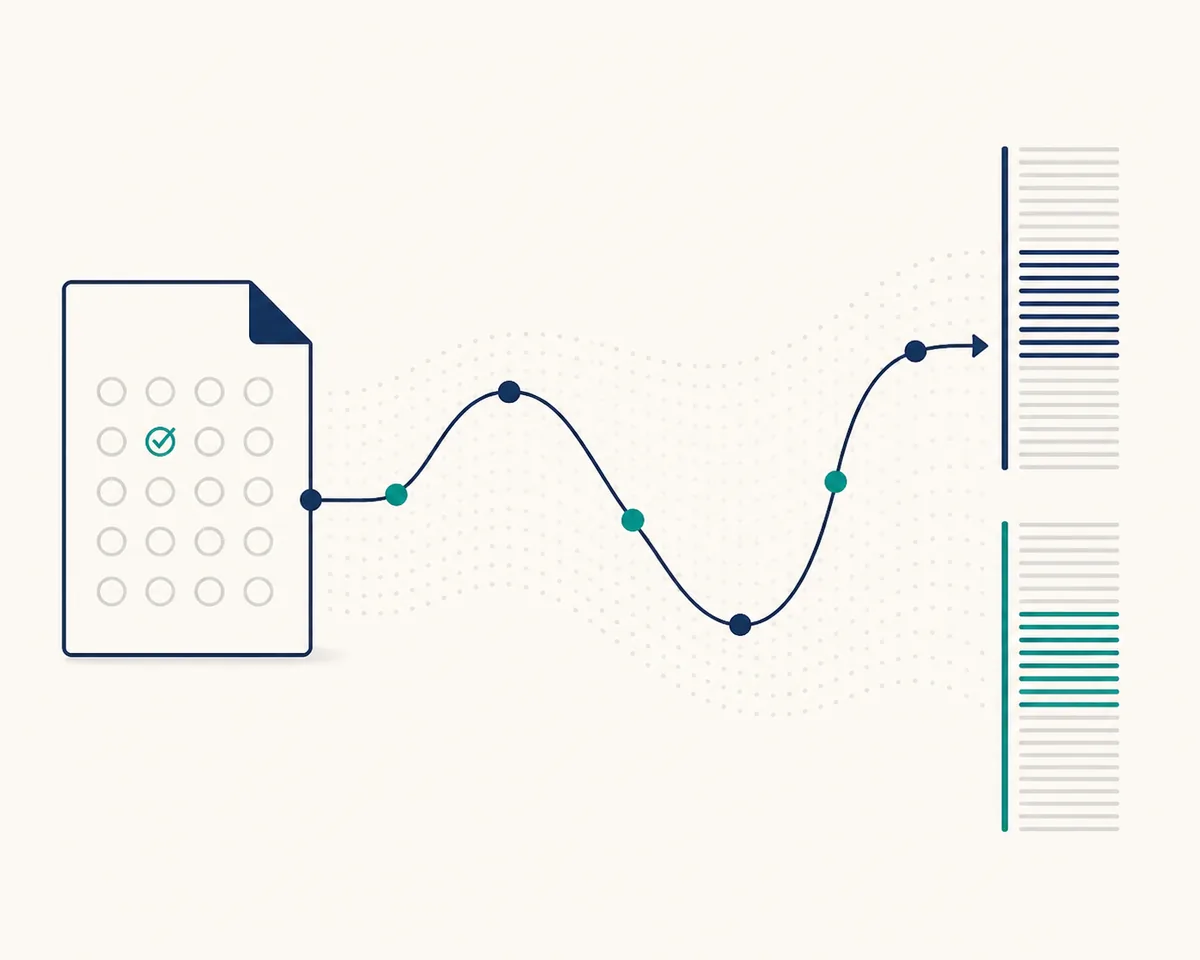
The SAT Score Range at a Glance
The answer to “what is the SAT out of?” depends on whether you mean the total or one section.
When students ask, “what is the SAT out of?”, the direct answer is a 400–1600 total scale for the current digital SAT. It is the sum of two section scores: Math and Reading and Writing. Each section is reported from 200 to 800, so the two section ceilings add to 1600. A student cannot receive an official total above 1600 or below 400.
That range answers the maximum-score question, but it does not describe how many questions you must answer correctly. Keep practice-test section results separate before interpreting the combined total.
| Score item | Reported range | How to read it |
|---|---|---|
| Total SAT score | 400–1600 | Math plus Reading and Writing |
| Math section | 200–800 | One of the two scaled section scores |
| Reading and Writing section | 200–800 | The second scaled section score |
| Raw practice result | Form dependent | Correct answers used for an estimate, not a final 400–1600 score |
The SAT is out of 1600 total points, with each section out of 800. The 400–1600 scale is the official reported range.
How the 400–1600 Total Is Built
The total is addition, not an average and not a percentile.
Once the two section scores are reported, the calculation is simple: add Math and Reading and Writing. A 760 Math plus a 740 Reading and Writing score produces a 1500 total. A 700 plus 700 produces 1400. The arithmetic is easy; estimating the section scores from raw answers is the part that needs a form-specific reference.
This also explains why a total score by itself does not tell you which skill needs attention. Two students can both earn 1400 with different section splits, such as 720 Math plus 680 Reading and Writing or 680 Math plus 720 Reading and Writing. Use each section score when setting a study target or comparing a practice result.
Total score
Add the two reported section scores. Do not average them and then multiply by two; direct addition already produces the 400–1600 total.
Section balance
A balanced 1500 might be 750 + 750, but other splits are valid. The same total can reflect different Math and Reading and Writing strengths.
Why Each Section Stops at 800
The SAT has two scored sections, so the section scale and total scale have different ceilings.
Math has its own 200–800 scale, and Reading and Writing has its own 200–800 scale. The two sections are not combined into a single 1600-question test. The total ceiling is 1600 because 800 is the maximum for Math and 800 is the maximum for Reading and Writing.
The digital SAT is divided into two modules within each section. Module 1 performance helps determine the difficulty mix in Module 2. That structure matters when you estimate a score from correct answers, but it does not change the public score range: every official section score still fits inside 200–800.
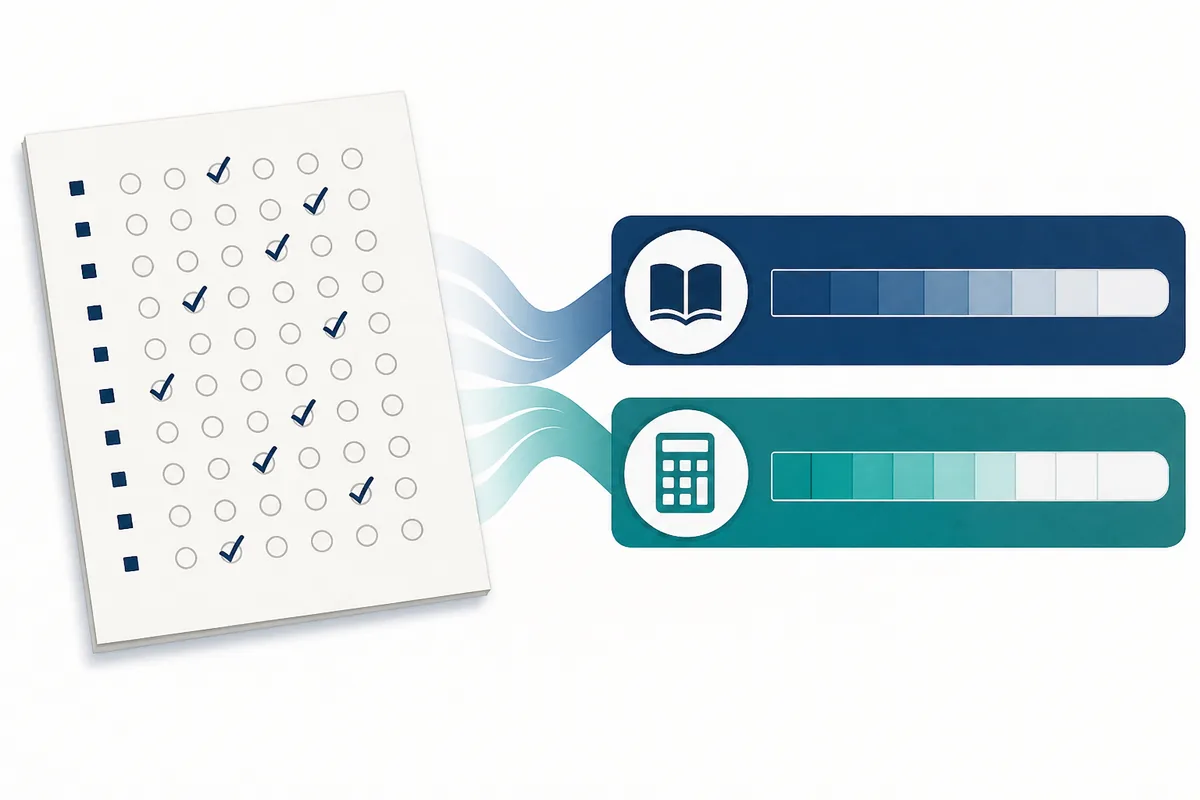
Two section ceilings
Think of the score report as two 800-point lanes that add together. A result cannot move beyond either lane's 800-point ceiling.
Format matters
Older SAT references may describe a different format. For a current practice test, use the digital SAT structure and the matching score reference.
Can You Get a Decimal SAT Score?
A number such as 1560.5 can be useful in a spreadsheet, but it is not an official SAT score report value.
Official SAT scores are reported on the published score scale in ten-point increments. That means a score report uses values such as 1400, 1410, 1420, or 1560 rather than a decimal like 1560.5. The scale is designed for reporting a standardized result, not for showing every fractional estimate a calculator might produce.
A practice calculator may calculate an intermediate value or display a range when the exact conversion table is unknown. Treat that display as an estimate. If a tool shows a decimal, read its rounding rule and use the nearest reported score only as a planning shorthand; do not claim that the decimal is an official score.
Use whole reported scores when you discuss an SAT result. Keep any fractional calculator output in the notes as an estimate and explain how it was rounded.
Why Raw Answers Do Not Equal the Final Score
The maximum score is fixed, but the path from correct answers to a section score is not a fixed points-per-question formula.
A correct answer contributes to a raw count within its section. That raw count is useful for reviewing a practice test, yet it is not the same thing as a 200–800 section score. Math and Reading and Writing have different numbers of questions, and the digital SAT uses adaptive modules and an equating process to keep forms comparable.
For example, “I got 42 Math questions right” tells you the raw result for that practice form. It does not automatically mean 760, 770, or any other one score. The conversion depends on the form and the information available for that test. A score chart or the matching practice-test key is more useful than multiplying a percentage by 800.
| Example section split | Total arithmetic | What it does not prove |
|---|---|---|
| 800 Math + 800 Reading and Writing | 1600 | It does not reveal the raw answers needed on every form. |
| 760 Math + 740 Reading and Writing | 1500 | It is not a percentile or a guarantee of admission. |
| 700 Math + 700 Reading and Writing | 1400 | It does not say that both sections had the same raw percentage. |
How to Use the Range When Reviewing a Practice Test
Start with the official range, then add the details that make a practice estimate useful.
If you are checking a Bluebook practice test or another official practice form, write down Math and Reading and Writing separately. Record the number correct, the test form, and whether the result came from an adaptive digital test or a paper conversion. Those details make the estimate easier to reproduce.
Next, compare the section estimates with your target total. If the goal is 1500, decide whether you need a balanced 750 + 750 or another split that fits your strengths. A total score chart can show the arithmetic range, while a section calculator can help you investigate the raw result. Neither should replace the official score report after a real test.
- Write down the Math and Reading and Writing results separately.
- Confirm the practice-test form and use its matching conversion reference when available.
- Add the two scaled section estimates instead of averaging raw percentages.
- Label any calculator output as an estimate and keep the official 400–1600 range in view.
- Review the section with the larger gap to your target before taking another full test.
Try the SAT score calculator for a practice estimate, compare ranges in the SAT score chart, or read the Digital SAT scoring guide for the adaptive-scoring context.
SAT Maximum-Score FAQ
Direct answers to common questions about the SAT total, section ceilings, and score decimals.
What is the SAT out of?
The current SAT is out of 1600 total points. It combines a Math score from 200 to 800 with a Reading and Writing score from 200 to 800.
What is the highest possible SAT score?
1600 is the highest possible total: 800 in Math plus 800 in Reading and Writing. It is the ceiling of the published score scale.
What is the lowest SAT score?
The published total scale begins at 400, which corresponds to the 200 minimum in each section. A practice calculator may show a different intermediate estimate, but the official range starts at 400.
Can you get a decimal score on the SAT, such as 1560.5?
No. Official SAT results are reported on the standard score scale in ten-point increments, so a decimal is not an official score. A calculator can show a fractional estimate, but it should be labeled and rounded according to its method.
Is each SAT question worth a fixed number of points?
No. A correct answer contributes to a raw section count, but the scaled score is produced through the test's scoring and equating process. There is no universal rule that every missed question costs the same number of scaled points.
Does the SAT score range include an essay?
No. The current digital SAT total is Math plus Reading and Writing. An older essay or 2400-point description refers to a different SAT format.
Keep the SAT Range and the Estimate Separate
If you are still asking “what is the SAT out of?”, remember the direct answer: 1600 total, with two section scores that each run from 200 to 800. Use that range to read an official result, then use section-specific and form-specific evidence to estimate a practice score. A decimal or a universal points-per-question rule can make a rough calculation look more exact than it really is.
Official sources
- College Board — Understanding SAT Scores — Official score ranges and interpretation for the current SAT.
- College Board — How SAT Scores Are Calculated — Official explanation of raw scoring, adaptive modules, and score conversion.
- College Board — How the SAT Is Structured — Official section and module structure for the digital SAT.